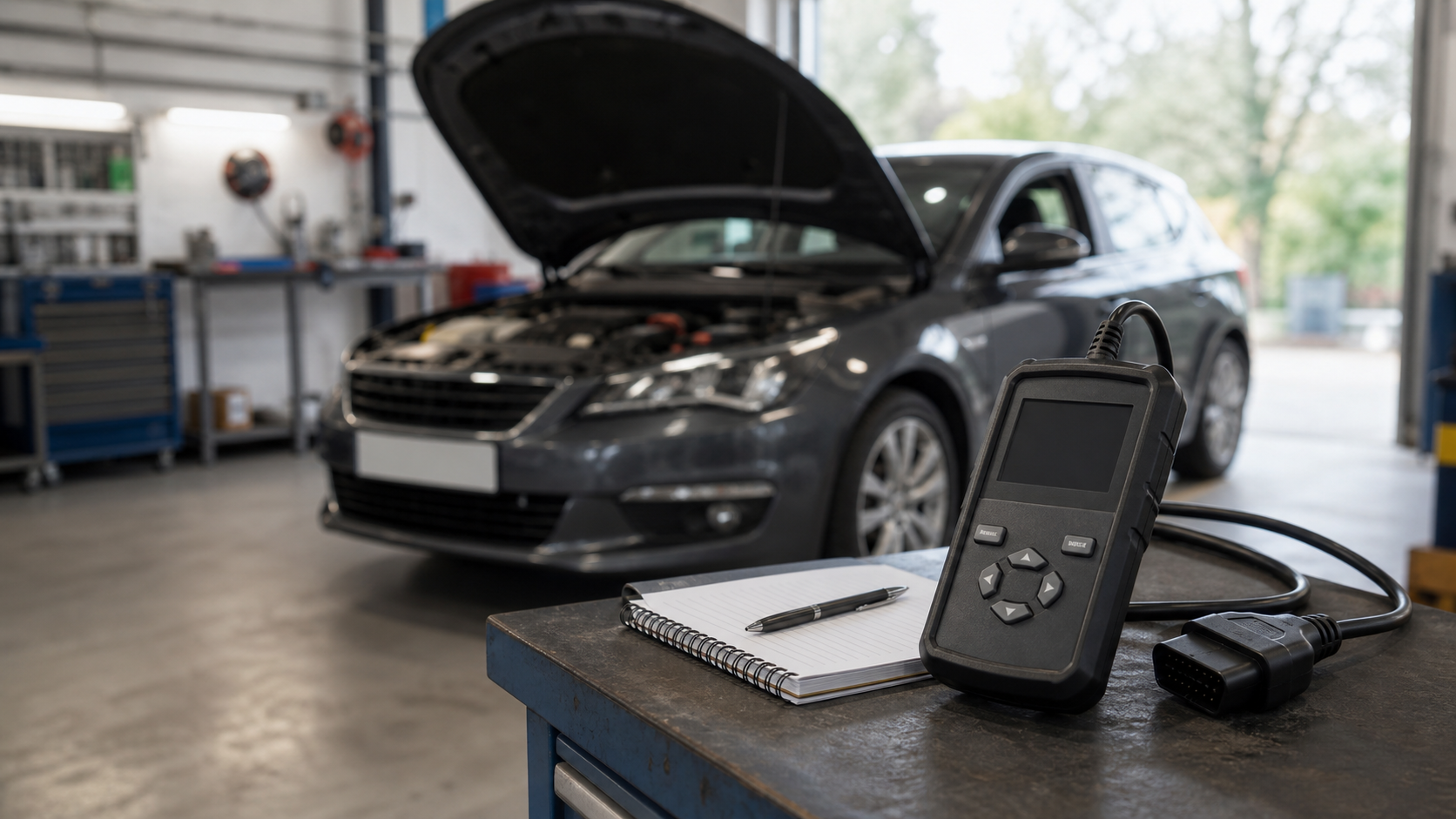
TL;DR: An OBD2 scanner UK buyers should prioritise real system coverage over headline price. Most modern British cars expose a standard OBD2/EOBD port, but cheap tools often read only generic engine codes. Based on our testing at CodeReader UK, a capable scanner should match your make and model, show live data you can understand, and — if you run a diesel or maintain multiple vehicles — support ABS, SRS and service functions such as DPF and battery resets.
If you have ever watched a dashboard warning light appear and wondered whether you need a garage visit or just a loose fuel cap, you are exactly the audience for this guide. UK drivers on tight budgets frequently ask which OBD2 scanner actually reads their vehicle properly — especially on popular marques such as Vauxhall, Ford and VW Group — without paying dealership diagnostic fees every time something lights up.
What is an OBD2 scanner?
An OBD2 scanner is a handheld or app-based tool that connects to your car's onboard diagnostics port to retrieve fault codes, live sensor readings and emissions readiness status. In the UK, petrol cars registered from 2001 and diesel cars from 2004 generally comply with EOBD/OBD2 standards for engine-related diagnostics.
The port is usually found beneath the steering column. Once connected with the ignition on, the scanner requests data from the engine control module and displays diagnostic trouble codes (DTCs) such as P0300 (random misfire) or P0420 (catalyst efficiency). Better units translate those codes into plain English and show whether monitors are ready for an MOT emissions check.
Why UK drivers search for an OBD2 scanner
Real-world forum posts from British motorists highlight a consistent pattern: a service or check-engine light appears, basic pedal-test tricks show nothing useful, and the driver is unsure which affordable scanner will actually read manufacturer-specific data. Finances are often tight, so the goal is to avoid buying the wrong tool twice.
Common motivations include:
- Understanding a warning light before booking a garage
- Checking whether a car is safe to drive or should be recovered
- Preparing for MOT when emissions or safety lamps are illuminated
- Verifying that a DIY repair actually cleared the fault
- Running a quick scan on a used car before purchase
An OBD2 scanner does not replace a trained technician, but it helps you ask better questions and spot when a quote does not match the reported fault.
Generic OBD2 vs four-system scanners
Many sub-£40 devices sold online are generic code readers. They may clear a check-engine light and read standard powertrain codes, yet fail completely on ABS, airbag or transmission modules. That limitation surfaces quickly on modern UK cars where multiple warning lamps can be related.
A four-system scanner such as the TOPDON ArtiDiag600S 4-system OBD2 scanner accesses engine, automatic transmission, ABS and SRS modules from one handheld unit. It also performs nine maintenance resets — including oil service, DPF, battery matching (BMS), TPMS and steering-angle sensor (SAS) — with free lifetime Wi-Fi updates on Android 11. At £470.52 inc. VAT, it costs more than a basic reader, but it is the category of tool owners keep for years rather than outgrow within months.
Will an OBD2 scanner work on your UK car?
Compatibility is not universal. Always verify make, model, year and the systems you need before purchase. Standard OBD2 engine functions are widely supported, yet Vauxhall, Ford, BMW, Mercedes and other manufacturers store additional codes that basic readers never surface.
Practical checks before buying:
- Confirm EOBD/OBD2 support for your registration year
- Check whether ABS and SRS access is listed for your platform
- Look for service-reset functions you will actually use
- Prefer tools with ongoing software updates rather than fixed firmware
If you only need occasional engine-code checks on one petrol car, a simpler reader may suffice. If you maintain a diesel, run a small workshop or want one device for family vehicles, broader coverage is usually cheaper over time than repeated garage diagnostics.
Key features worth paying for
Readable live data
Codes alone rarely tell the full story. Live data streams — fuel trim, coolant temperature, battery voltage, wheel-speed sensor readings — help confirm whether a sensor is genuinely out of range or reporting a symptom of another fault.
Clear interface
Raw P-codes without context frustrate home users. Look for sensible menus, plain-English descriptions and a screen you can read in a dim garage.
Updates and support
Vehicle platforms evolve. A scanner with free lifetime updates — like the ArtiDiag600S — stays useful as new models and functions are added, without annual subscription fees.
UK buying confidence
Order from a UK-based supplier offering tracked delivery, straightforward returns and a proper warranty. CodeReader UK ships from a UK warehouse with a 2-year warranty and 30-day returns on eligible orders.
How to use an OBD2 scanner safely
- Park safely, apply the handbrake and turn the ignition on without starting the engine unless the tool requires it.
- Locate the OBD2 port beneath the dashboard and connect the cable firmly.
- Read stored and pending codes, then note live data if available.
- Research the code and symptoms before replacing parts.
- Clear codes only after the underlying fault is repaired, then verify monitors complete a drive cycle.
Never ignore airbag, brake or steering warnings while relying only on a basic engine reader. If safety-system lamps stay on, use a scanner with appropriate module access or seek professional inspection.
When to upgrade from a basic reader
Upgrade when you encounter any of the following:
- ABS, SRS or transmission warnings your current tool cannot read
- Diesel maintenance tasks such as DPF or battery matching
- Multiple vehicles with different software requirements
- Repeated garage diagnostic charges for scans you could run at home
For a deeper comparison of categories, see our OBD diagnostic tool explained guide.
Frequently Asked Questions
What is the best OBD2 scanner for UK cars?
There is no single best model for every driver. Match the tool to your vehicles and tasks: a basic reader for occasional engine codes, or a four-system scanner with service resets if you need ABS, SRS, transmission and diesel maintenance functions.
Will a cheap OBD2 scanner read Vauxhall and Ford codes?
Many cheap units read generic engine codes on UK-compliant vehicles but miss manufacturer-specific faults. Check compatibility lists carefully if you own Vauxhall, Ford, VW Group or other mainstream British-market brands.
Can an OBD2 scanner help before an MOT?
Yes, for preparation. It can reveal stored faults and readiness-monitor status before the test date. It does not replace the MOT itself, and certain warning lamps remain automatic failures under DVSA rules.
Ready to compare a professional 4-system scanner?
Free UK delivery · 2-year warranty · Free lifetime updates