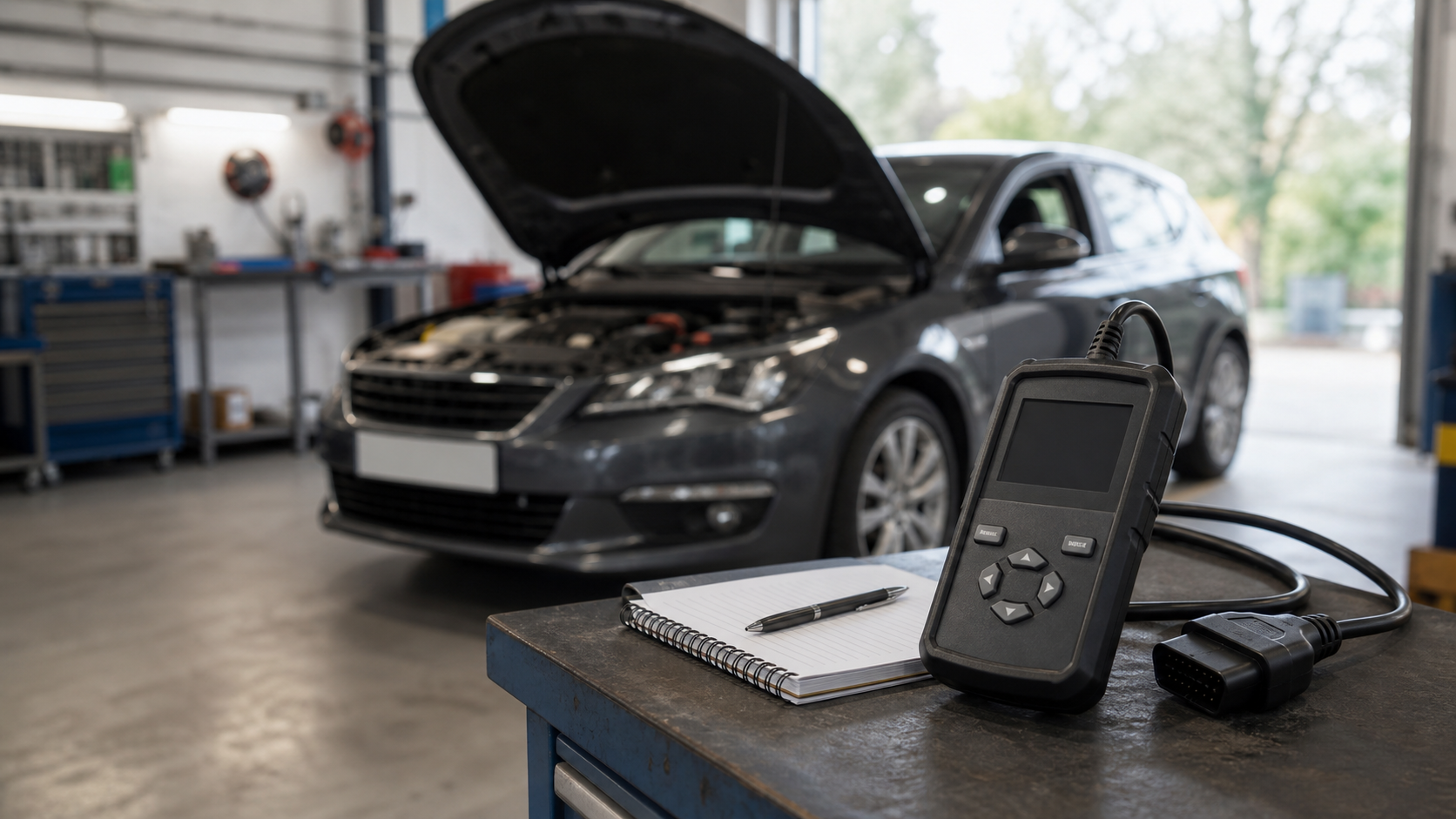
Car Fault Code Reader Explained: A UK Buyer's Guide

TL;DR: A car fault code reader is a handheld diagnostic device that plugs directly into your vehicle's OBD2 port to translate dashboard warning lights into clear, actionable data. Based on our testing at CodeReader UK, using a quality scanner allows you to instantly read and clear engine, ABS, and transmission error codes, helping you identify faults accurately, avoid unnecessary garage fees, and ensure your car is fully prepared for its MOT.
According to UK MOT guidelines, an illuminated engine management light is an instant failure. Consequently, a warning light on the dash can mean anything from a loose sensor connection to a severe fault that will affect emissions, braking support, or drivability. A good car fault code reader helps you find out exactly what the vehicle is trying to tell you before you book into a garage, purchase parts you do not need, or risk a failed MOT.
For UK drivers, this preventative approach matters immensely. The RAC has reported that battery issues, electrical faults, and engine management problems remain common causes of breakdown call-outs, and modern cars rely heavily on onboard electronics to monitor these complex systems. Source: RAC breakdown advice. Ultimately, a fault code reader gives you a practical first step: read the codes, check live data, and understand whether the issue is minor, urgent, or requires professional repair.
Based on our professional experience at CodeReader UK, our focus is firmly on tools that go beyond basic fault clearing. The site’s core message is clear: the professional OBD2 code reader is essential for deep vehicle diagnostics. Furthermore, that means more than just reading generic engine codes. The right unit can diagnose Engine, ABS, SRS, and Transmission systems, support 9 essential service resets, and offer free lifetime updates so the tool remains highly useful as vehicles and software standards evolve.
Key Takeaways
- A car fault code reader plugs directly into your vehicle’s OBD2 port and reads diagnostic trouble codes (DTCs) stored by the car’s control modules.
- Basic readers cover standard engine fault codes; however, premium tools also access ABS, airbag, transmission, and service functions.
- For UK buyers, compatibility with both petrol and diesel vehicles, MOT readiness checks, emissions monitoring, and common British-market brands is absolutely essential.
- Live data, freeze frame data, VIN lookup, service resets, and free lifetime updates make a diagnostic tool far more useful throughout real-world vehicle ownership.
- While a code reader does not replace a qualified technician, it can significantly save time, reduce guesswork, and help you make informed repair decisions.
What exactly is a car fault code reader?
A car fault code reader is a dedicated diagnostic tool that connects to a vehicle’s OBD2 port, which is usually found tucked beneath the dashboard on the driver’s side in most UK cars. Essentially, it reads trouble codes generated by the vehicle whenever a sensor, control module, or monitored system detects a problem.
These codes are commonly referred to as DTCs, or diagnostic trouble codes. Furthermore, they are standardised across the industry, which is why even entry-level readers can access many engine-related faults on vehicles sold in the UK since the OBD2 and EOBD standards became mandatory.
However, what separates a basic reader from a highly capable one is the depth of access. For instance, a simple tool may only read and clear generic engine fault codes. Conversely, a professional-grade reader can access manufacturer-specific codes, display live sensor data, check emissions readiness monitors, and communicate with complex systems such as ABS, SRS (airbags), and automatic transmission control units.
If you want a broader grounding in scanner types and their specific capabilities, please see The Ultimate Guide to Automotive Diagnostic Scanners in the UK.
How does a car fault code reader work?
When a mechanical or electrical fault occurs, the car’s Engine Control Unit (ECU) or another specific control module stores a unique code. The reader retrieves that code through the onboard diagnostics system. From there, you can view the code itself, read a plain-English description on many modern devices, and often view supporting freeze-frame data that helps confirm the root cause.
How do I read fault codes?
First and foremost, the primary function is code retrieval. You simply connect the tool to the OBD2 port, switch the vehicle's ignition on (without starting the engine), and initiate a scan. The reader subsequently checks for current, pending, and stored codes. Current codes relate to active, ongoing faults. Pending codes typically indicate an issue that is developing over multiple drive cycles. Meanwhile, stored or historic codes may refer to faults that occurred previously but still remain safely logged in the system's memory.
How do I clear fault codes?
Most readers can successfully clear codes after a repair has been completed. While this is incredibly useful, it should not be the sole reason for buying one. Crucially, clearing a code without fixing the underlying cause usually means the warning light will inevitably return. Moreover, on some faults, the vehicle's system requires a successful drive cycle before the light permanently stays off.
Can I view live engine data?
Live data is precisely where a superior tool starts to justify its price tag. With this feature, you can monitor engine revs, coolant temperature, oxygen sensor readings, fuel trims, battery voltage, and various other values in real time. Consequently, this helps identify whether the issue is a failing sensor, a fuelling problem, or a frustratingly intermittent electrical fault.
What are emissions readiness monitors?
For UK drivers, readiness monitors matter significantly because they indicate whether the vehicle's internal emissions self-checks have fully completed. If you have recently cleared a fault code, the car may not yet be ready for an emissions-related test scenario, and unresolved issues can still trigger MOT trouble. Based on our testing, a proper reader helps you verify this status well before you arrive at the test centre.
Is it worth buying a car fault code reader?
There are several highly practical reasons a code reader has quickly become one of the most useful tools a British driver can keep in their garage.
To eliminate costly guesswork
A dashboard warning light alone tells you very little. Fortunately, a code reader narrows the fault down almost instantly. As a result, that can stop you from replacing expensive parts on mere suspicion, which is often far more costly than buying the right diagnostic tool in the first place.
To prepare for an upcoming MOT
Many savvy buyers want to check emissions-related faults and monitor readiness status prior to their annual MOT test. If an engine management light is currently on, or if a recently cleared code suddenly returns, the reader provides an invaluable early warning.
To challenge vague repair advice
While most UK garages are highly professional and honest, plenty of motorists prefer to arrive fully informed. If you already know the stored codes and can describe the symptoms with confidence, conversations about diagnosis and labour costs become much clearer and faster.
To confidently inspect a used car
A portable car fault code reader is an exceptional tool when viewing a second-hand vehicle. It can quickly reveal stored or pending faults that may not be obvious during a short test drive. For buyers looking at high-mileage diesel estates, family SUVs, or ex-fleet vehicles, this capability is especially valuable.
To support safe home maintenance
DIY owners carrying out routine jobs such as battery replacements, throttle body cleaning, or standard service checks often want to confirm the car has no hidden faults afterwards. In these scenarios, a reliable reader adds absolute reassurance.
What is the difference between a basic code reader and a professional tool?
Not every car fault code reader offers the exact same level of system access. Unfortunately, this is where many UK buyers get caught out when purchasing cheap, unbranded units.
What a basic car fault code reader usually includes:
- Read and clear generic engine fault codes.
- Turn off the check engine light after a successful repair.
- View a very limited set of live engine data.
- Read I/M readiness or standard emissions monitor status.
Where basic diagnostic tools fall short:
- No access to ABS (Anti-lock Braking System) faults.
- No access to SRS or airbag control modules.
- No automatic transmission diagnostics.
- No crucial service reset functions (e.g., oil light resets, electronic parking brake retraction).
- Highly limited manufacturer-specific code support.
- Few or no software updates, meaning the tool quickly becomes obsolete as new cars are released.
Frequently Asked Questions (People Also Ask)
Can any fault code reader read all cars?
No. While all OBD2-compliant readers can access basic engine codes on UK cars manufactured after 2001 (petrol) and 2004 (diesel), advanced systems like ABS and airbags require a reader with specific manufacturer software compatibility.
Will a code reader tell me exactly what part to replace?
Not always. A car fault code reader tells you which sensor or system has registered a fault, but it is up to you (or your mechanic) to determine if the sensor itself has failed, or if there is a wiring issue causing the sensor to trigger the code.
Can I leave a code reader plugged in while driving?
Yes, many drivers leave Bluetooth or Wi-Fi OBD2 dongles plugged in to monitor live data while driving. However, for handheld diagnostic tools, it is best to only plug them in while actively diagnosing an issue to avoid draining the battery or tangling cables near the pedals.
Ready to upgrade your toolkit with CodeReader UK?
Upgrade Your Diagnostics — £470.52